
What Is DCAM? A Complete Guide to the Data Management Capability Assessment Model (v3)
A data leader may know that governance needs work without knowing where to begin. One team has a glossary, another has quality checks, and a third has a cloud migration plan. Are these isolated projects, or parts of a coherent Data Management capability? That is the question the DCAM framework helps an organisation answer.
DCAM stands for Data Management Capability Assessment Model. Developed by the EDM Association, it sets out the capabilities needed to establish and sustain a Data Management and analytics programme. Its assessment approach asks whether those capabilities exist in practice, who is engaged, which processes are repeatable and what evidence supports the answer. DCAM v3 is the current major version described by the Association. It is used to assess an organisation; professionals can also train in the framework and earn an individual DCAM certification.
What Is DCAM Used For?
The most direct use is a DCAM assessment: establishing where a Data Management programme stands and where its gaps are. A CDO might use the findings to decide whether to invest first in business definitions, Data Quality controls, operating model changes or architecture. The result is more useful when it becomes a prioritised roadmap with owners and funding than when it remains a maturity score.
DCAM can also give different teams a common set of questions. If a governance policy exists but no one can show how it is applied, the discussion moves from “we have a policy” to “what is working, and what evidence can we show?” The EDM Association describes both internal self-assessments and assessments with authorised partners, as well as benchmarking and business-case development. Access to the full DCAM framework is reserved for member firms and authorised partners under the Association’s terms.
An assessment concerns organisational capability, not the competence of one employee. That distinction matters when someone searches for “DCAM certification”: an individual certification tests knowledge of the framework, while a DCAM assessment examines how an organisation manages data.
How Does the DCAM Framework Work?
The EDM Association describes DCAM v3 as eight core components containing 34 capabilities and 101 sub-capabilities. The components cover Data Strategy and the business case; programme funding; business, data and technology architecture; Business Data Knowledge; Data Quality; governance; operations, risk and control; and analytics management. Together, they make it harder to mistake a collection of tools for a functioning Data Management programme.
Each sub-capability has a description, objectives, challenge questions, expected evidence and scoring criteria. For example, a team assessing Data Quality would look beyond whether a dashboard exists. It would ask who defines the rules, how issues are escalated, whether controls run consistently and what artefacts demonstrate that the process works. The example illustrates how to use the model; the exact assessment criteria come from the licensed framework.
DCAM scoring examines engagement, process and evidence. Engagement concerns whether the right people have authority and participate. Process asks whether practices are established and repeatable. Evidence means the artefacts an assessor can inspect. This makes the conversation more concrete: a stated intention is different from an operating control supported by records.
Organisations do not have to fix every gap at once. The useful next step is to connect assessed weaknesses to business priorities, dependencies and available resources, then revisit the relevant capabilities as the programme changes.
What’s New in DCAM v3?
Version 3 updates the framework for cloud-native architectures, modern data pipelines and AI/ML integration. The EDM Association’s launch announcement also describes stronger attention to governance, privacy, security and regulatory demands. These changes matter when a Data Management programme must support AI or operate across hybrid and cloud environments rather than a single traditional platform.
The structural change is easier to see: v3 consolidates architecture capabilities into one component and introduces Business Data Knowledge as a component. The Association describes the overall framework as more streamlined. That does not mean a v2 assessment can simply be relabelled v3; teams should review which capabilities, evidence and scoring expectations have changed before comparing results across versions.
DCAM v3 is not an AI certification or a cloud security standard. Its wider Data Management scope now addresses the capabilities those initiatives depend on. For organisations moving from v2, this is a reason to check the specific version used in training and assessment materials.
DCAM vs DAMA-DMBOK and CDMP
These names sit close together in Data Management discussions, but they answer different questions.
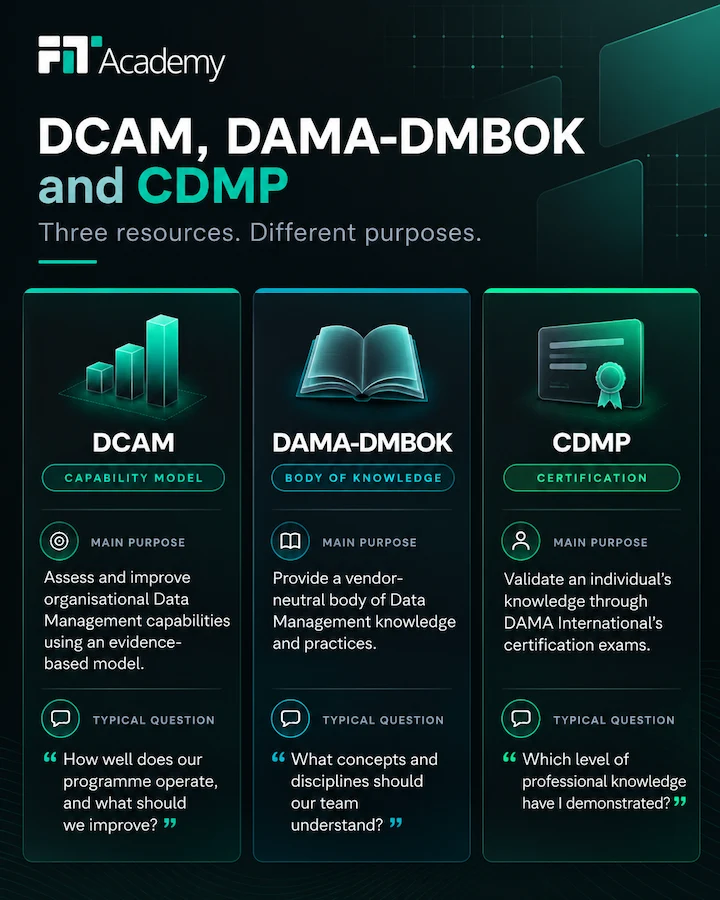
DAMA International describes DAMA-DMBOK as a body of knowledge rather than a prescriptive implementation method. Its CDMP certification is based on that knowledge base. DCAM, by contrast, gives an organisation an assessment structure with questions, evidence and scoring. DCAM also has its own individual certification, which validates knowledge of DCAM rather than conferring CDMP.
The paths can complement each other. A professional might use CDMP to formalise broad Data Management knowledge and DCAM training to learn how to assess a programme’s capabilities. For the levels and exams in the DAMA route, see FIT Academy’s CDMP certification guide.
Who Should Learn DCAM?
CDOs and Data Leaders can use the model to turn broad ambitions into assessable capabilities and a defensible investment sequence. It helps them ask whether a programme has the operating model, funding and evidence to support its goals.
Data Governance and Data Quality Managers can use DCAM to understand how their work connects with architecture, business knowledge, risk and analytics. A strong local control may still depend on an unclear enterprise definition or an absent decision owner.
Consultants, architects and programme teams may find the framework useful when they need a shared assessment language across functions. Learning the model does not by itself authorise someone to conduct client assessments: the EDM Association sets separate access and authorised-partner conditions for use of the full framework.
Teams considering a corporate course should identify their purpose first. A leadership group seeking a common vocabulary needs a different discussion from a team preparing to gather evidence for a formal assessment.
How to Get DCAM Certified
DCAM certification is an individual credential connected to training and an exam. The EDM Association states that completing DCAM v3 training and passing the exam leads to a digital certification badge. FIT Academy’s course page likewise distinguishes its attendance certificate from a certification badge issued after an exam pass. Attending a course alone is therefore not the same as becoming certified.
For a new learner, the practical sequence is to choose a v3 course, study the eight components and their assessment logic, complete the training, and pass the applicable exam. The EDM Association also offers a v3 update route for some people previously certified in v2. Check the provider’s current exam arrangements and eligibility before booking; the Association states that access to its framework and training is linked to membership. An individual’s DCAM badge should also not be confused with organisational recognition through the Association’s Data Excellence Programme.
DCAM Training with FIT Academy
FIT Academy’s DCAM training page describes an interactive course on Data Management capabilities, with practical examples and discussion among participants. It lists a live cohort on 9–10 November 2026, 10:00–17:00 CET, and an enterprise option for groups of more than ten. The page lists English and Italian as course languages, so prospective participants should confirm the language of the specific cohort and its exam arrangements when registering.
For an individual, the value of training is learning to read DCAM as an assessment model rather than memorising a list of components. For a company, a shared course can help leaders, governance teams and technical specialists work from the same definitions before planning an assessment or improvement roadmap. FIT Academy’s enterprise option provides a route to discuss group requirements directly.
Is DCAM a framework or a certification?
Both uses of the name exist. DCAM is an organisational Data Management capability framework. An individual can separately earn DCAM certification by completing the relevant training and passing the exam.
What does a DCAM assessment measure?
It evaluates how an organisation’s Data Management capabilities operate, using questions, processes, participation and auditable evidence. The findings can support a roadmap and investment decisions; they do not certify every employee.
How many components are in DCAM v3?
The EDM Association describes eight core components, 34 capabilities and 101 sub-capabilities in DCAM v3. Each sub-capability includes objectives, challenge questions, evidence and scoring criteria.
Is DCAM v3 different from CDMP?
Yes. DCAM assesses organisational capabilities and offers its own framework certification for individuals. CDMP is DAMA International’s professional certification based on DAMA-DMBOK. One does not replace the other.
Can my organisation use DCAM without joining the EDM Association?
The Association states that the full DCAM framework is available to member firms for internal use and to authorised partners for client work. Confirm access rights and assessment arrangements with the Association or a training provider before starting a formal programme.
Does a DCAM course automatically grant certification?
No. FIT Academy lists an attendance certificate for its course and says a certification badge follows a passed exam. Confirm the current exam process with the provider before enrolling.

If DCAM could help your team move from scattered Data Management initiatives to an evidence-based roadmap, start by learning how the framework assesses capability. Explore FIT Academy’s DCAM training and certification course for the next live cohort!