
CDMP Master Path with Mandala: a more complete Data Management learning journey
The CDMP Master Path by FIT Academy now includes Mandala – The Data Management Lab Framework Training Course, adding a broader perspective to advanced Data Management learning.
The aim is not simply to deepen knowledge of individual disciplines, but to understand how they connect in real organisations. Governance, Data Quality, Architecture, Security, Analytics, Artificial Intelligence, Project Management, Change Management and organisational culture are not isolated areas. Together, they shape an organisation’s ability to create value from data.
By integrating Mandala into the CDMP Master Path, FIT Academy adds a complementary perspective to certification preparation: one that helps professionals connect technical knowledge with people, organisational dynamics and Data Leadership.
What changes in the CDMP Master Path
The CDMP Master Path was designed to provide a structured and progressive learning journey for professionals who want to strengthen their Data Management expertise and prepare for the path towards CDMP Master certification.
At Master level, DAMA International recognises broad and deep knowledge of the discipline, supported by professional experience and strong examination performance.
With the inclusion of Mandala, the learning journey gains a second dimension.
On one side, the pathway continues to build knowledge around Data Management disciplines, professional terminology and the DAMA-DMBOK body of knowledge.
On the other, Mandala introduces a visual framework that helps professionals understand how different competencies reinforce one another in real organisational environments.
This means moving from an essential question:
“What do I need to know?”
to a more advanced one:
“How do I connect what I know to support decisions, people and change?”
This shift is what turns the study of individual domains into the development of a broader Data Leadership perspective.
Why Mandala makes the learning journey more complete
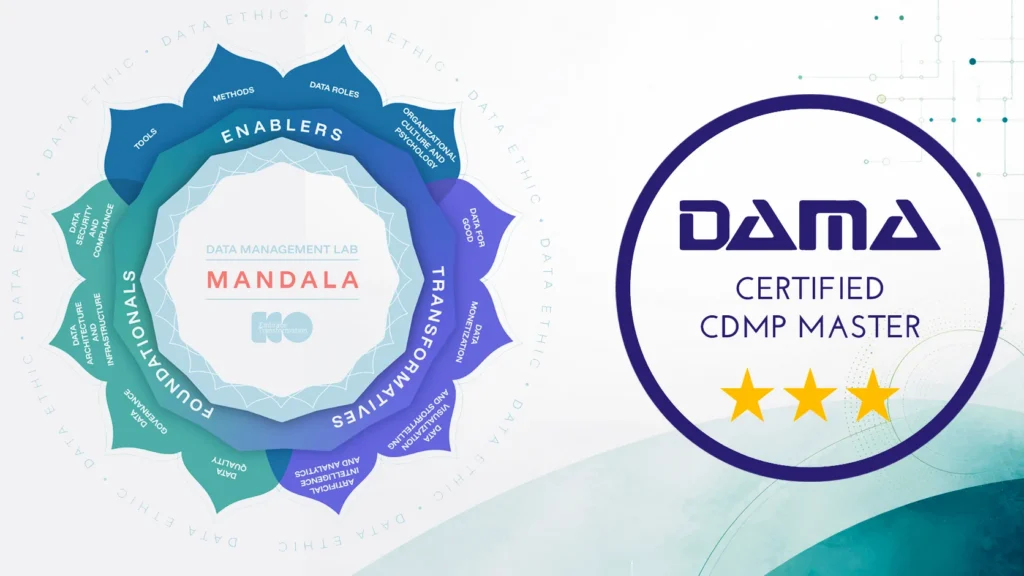
Mandala is the visual representation of the Data Management Lab Framework.
Its purpose is to provide a 360-degree view of the data domain by organising disciplines into three complementary groups:
Foundationals, Enablers and Transformatives.
Foundationals provide the foundations required to manage data in a reliable, governed and sustainable way.
Enablers connect methods, adoption and organisational capability.
Transformatives show how solid foundations and enabling capabilities can support innovation, Analytics, Artificial Intelligence and new forms of value creation.
One of the main strengths of Mandala is that it makes dependencies visible.
An AI initiative, for example, does not depend only on algorithms and infrastructure. It also requires Data Quality, clear accountability, security, ethics, processes, collaboration and the ability to support organisational change.
In the same way, a Data Governance programme does not deliver results simply because roles and policies have been defined. It needs to be understood, adopted and translated into everyday behaviours.
For professionals following the CDMP Master Path, this systemic perspective helps transform study into orientation and decision-making capability.
Concepts are no longer isolated within individual chapters. They become interconnected parts of a model that can help professionals analyse problems, discuss priorities and design more coherent interventions.
From certification preparation to practical application
A professional certification assesses knowledge and, at more advanced levels, also reflects experience and depth of expertise.
In real organisations, however, a Data Leader must go one step further: principles and frameworks need to be adapted to environments where priorities, people, technologies and constraints are constantly changing.
The integration of Mandala strengthens this bridge between preparation and application.
Its visual structure supports three particularly valuable capabilities:
- analysing a problem from multiple perspectives rather than relying on purely technical solutions;
- identifying missing capabilities before they become obstacles to a project;
- communicating the value of Data Management to non-specialist stakeholders.
The result is a learning experience that is closer to the real responsibilities of Data Managers, Chief Data Officers, consultants and senior data professionals.
Their role is not simply to oversee one domain, but to coordinate dependencies and create a shared language between business, technology and organisation.
DAMA-DMBOK and Mandala: complementary, not alternative
Mandala does not replace the DAMA-DMBOK and does not change the official requirements of the CDMP certification.
The two frameworks serve complementary purposes.
The DAMA-DMBOK provides an internationally recognised body of knowledge and forms the foundation of the CDMP examinations.
Mandala adds an educational and transformational perspective to the data landscape. It helps professionals understand the relationships between technical disciplines, transversal capabilities and human factors.
The distinction is therefore clear:
DAMA-DMBOK provides disciplinary structure and depth.
Mandala supports connection, orientation and application.
Bringing both perspectives into the same learning journey allows professionals to study with a broader map while keeping the role of each framework clearly defined.
The human factor in Data Leadership
Many Data Management programmes focus primarily on processes, roles, standards and technologies.
These elements are essential, but they are not enough.
Data transformation happens inside organisations made up of people, interests, habits and different levels of readiness for change.
The Data Management Lab Framework explicitly includes capabilities such as Project Management, Change Management, organisational culture and individual psychology.
This makes Mandala particularly relevant for professionals who need to influence decisions, support adoption and lead change rather than simply understand a methodology.
For a Data Leader, understanding the human factor means being able to build alliances, explain why governance matters, manage resistance and connect Data Quality to objectives that the business can recognise.
This is where knowledge becomes leadership.
A visual framework for navigating complexity
The Mandala format is not simply a graphic choice.
It represents integration, balance and the relationship between different parts of a system.
Applied to Data Management, it makes one principle immediately visible:
no discipline creates value in complete isolation.
This visual approach can support both learning and professional practice.
A professional can use it to identify areas for development.
A manager can use it to discuss team capabilities.
An organisation can use it as a starting point for conversations about maturity, priorities and dependencies.
The Data Management Lab book develops this approach through a practical structure designed for students, specialists and leaders.
The disciplines are presented as part of one interconnected landscape, from the foundations of Governance and Data Quality to AI, Analytics, Data Visualisation, Storytelling, culture and ethics.
A distinctive learning model within FIT Academy
The Data Management Lab Framework was developed within the Embrace Transformation community through the contribution of professionals from different organisations, industries and countries.
FIT Academy has translated this body of work into a dedicated learning experience focused on practical application.
FIT Academy offers a training course specifically dedicated to the Data Management Lab Framework Mandala.
The course explores the framework through practical examples, real-world cases and a transversal perspective that spans Data Governance, Data Visualisation, Data Quality, Artificial Intelligence and the organisational capabilities required to make data initiatives work in practice.
Including Mandala within the CDMP Master Path therefore adds a distinctive element to the learning journey.
Participants do not only access advanced certification-oriented content. They also gain a broader framework for understanding how technical knowledge connects with organisational capability and change.
Who can benefit from the new CDMP Master Path
The pathway is particularly relevant for professionals who want to build or strengthen a profile that combines specialisation with a broader strategic perspective.
It can be valuable for:
- Data Managers and Data Leaders;
- Chief Data Officers;
- senior consultants;
- Data Governance and Data Quality professionals;
- technical specialists who want to better understand the organisational context around data;
- professionals preparing for Practitioner or Master-level CDMP development.
It is especially relevant in complex and data-driven environments, where the quality of decisions depends on the ability to connect Governance, Architecture, Security, Analytics, people and organisational change.
In these contexts, expertise in a single discipline remains important.
Understanding how to orchestrate the wider system becomes even more valuable.
From certified professional to complete Data Leader
The value of an advanced learning journey is not measured only by the amount of content it contains.
It is also measured by the quality of the connections it helps professionals build.
With Mandala, the CDMP Master Path strengthens certification preparation while adding a perspective that takes learners beyond the exam.
Certification remains an important professional milestone.
Mandala helps turn that body of knowledge into an integrated, communicable and applicable perspective.
It is the combination of these two elements — professional rigour and systemic understanding — that makes the FIT Academy learning journey more complete
Want to prepare for CDMP certification while developing a broader perspective on Data Management?
Explore the FIT Academy CDMP Master Path and combine certification preparation, systemic thinking and Data Leadership in one complete learning journey.
What is the FIT Academy CDMP Master Path?
It is an online, self-paced learning journey designed to provide structured and advanced preparation in Data Management, supporting professionals who want to strengthen their expertise and progress towards CDMP Master-level development.
What is the Data Management Lab Framework, Mandala?
Mandala is the visual representation of the Data Management Lab Framework, a model that connects data disciplines across three groups: Foundationals, Enablers and Transformatives.
It helps professionals understand Data Management as a technical, organisational and human system.
Does Mandala replace the DAMA-DMBOK?
No.
The DAMA-DMBOK remains the recognised body of knowledge on which the CDMP certification is based.
Mandala complements it with a visual and transversal perspective that helps professionals understand relationships between disciplines and apply them in organisational contexts.
Why is Mandala useful for professionals preparing for CDMP?
Because it supports a broader view of Data Management.
It helps professionals connect Governance, Data Quality, Architecture, Security, Analytics, AI, Change Management and organisational culture, turning study into a more practical capability for analysis, decision-making and leadership.
What is the main benefit of the updated CDMP Master Path?
The main benefit is the combination of certification preparation and systemic understanding.
Professionals strengthen their knowledge of individual disciplines while also learning to understand their interdependencies, organisational impact and contribution to business value.