Enterprise organizations accumulate data continuously: legacy repositories, duplicated files, abandoned applications, shadow systems. Most organizations recognize that data volumes are growing. Far fewer have a controlled and defensible strategy to manage reduction.
In many enterprises, 50–70% of stored data is never accessed after creation, so called “dark data”.
Over time, this uncontrolled growth creates:
Redundant repositories
Multiple copies of the same data scattered across systems
Legacy systems no one owns
Outdated platforms consuming resources with unclear ownership
Exponential storage growth
Data volumes increasing faster than business needs
Increased attack surface
More data points create more vulnerability exposure
Slower systems and decisions
Performance degradation and information overload
Keeping data is not neutral. It creates measurable exposure across security, cost, governance and environmental footprint.
Measured impact across security, infrastructure and organizational governance.
Security & Risk Reduction
Less unused data means:
Smaller attack surface
Fewer uncontrolled repositories
Easier application of protection policies
Infrastructure & Cost Optimization
Less unused data means:
Lower storage growth
Reduced cloud and infrastructure costs
Simplified system landscape
Improved system performance
Organizational Governance
Less unused data means:
Reduced duplication
Clearer data ownership
Faster access to relevant information
Improved productivity
Reducing data footprint helps lower your organization’s digital carbon footprint.
Even 100 GB of cloud storage can generate a carbon footprint comparable to driving 160 km.
As enterprise data volumes expand, so does the energy demand of cloud and data center infrastructures. Rationalizing data volumes is a practical step toward more energy-efficient and carbon-aware IT operations. For organizations with ESG reporting obligations, digital data footprint is becoming a measurable variable.
What is Data Decluttering?
A structured approach to identify and systematically eliminate data that no longer creates value for your organization. Unlike ad-hoc cleanup initiatives, Data Decluttering follows a proven methodology designed for enterprise environments.
Our ERASE methodology
ERASE is a FIT Academy proprietary method, consists of five steps designed to ensure the effective management of obsolete data and legacy application. Built on an “aware, not scare” principle, the method prioritizes shared understanding, governance alignment and measured execution.
E
EXPLORE
Assess the organization, map data sources and define business needs
Measured impact across security, infrastructure and organizational governance.
01 Data Decluttering Assessment
2-3 weeks
Enterprise-level mapping and ROT analysis.
02 Controlled Execution Sprints
Ongoing
Incremental deletion and system rationalization.
Beyond Decluttering: Strategic data reallocation
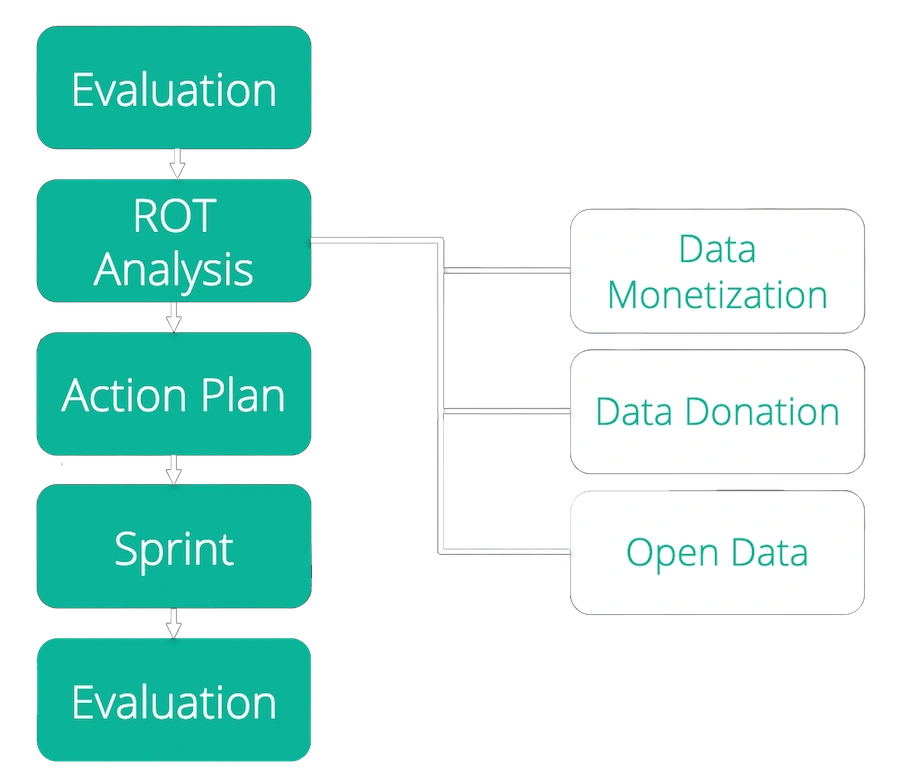
In the ROT Analysis phase, data that would typically be flagged for deletion can instead be leveraged in at least three ways: monetization (selling or exchanging data), donation (turning data into an asset that creates positive social impact), and open data (publishing selected datasets for the scientific community or other stakeholders). We can also support clients in managing each of these streams end to end.
Each member of our team has obtained the necessary certifications to provide the specialized services required within the ERASE method, from data management to security, and from regulatory compliance to data ethics.
The supporting team
Data Manager
Expertise in Governance and deep knowledge of architectural systems and databases.
IT Specialist
Specialized in diagnosing and analyzing information systems, with deep technical expertise across architectures, platforms, and enterprise environments.
Legal/Compliance Specialist
Expertise in ensuring regulatory compliance throughout the entire data deletion lifecycle, tailored to the specific requirements of the organization’s sector.
Data Engineers
Expertise in data analysis, data pipeline design and assessment, data profiling, and the overall comprehension of data flows across systems.
Project Managers
Accountable for project management, team coordination and stakeholder engagement.
Is your oganization storing more than it needs?
Data cleanup becomes a moment of reflection and organizational improvement, helping teams understand what they have, what they use, and what truly creates value.
Get a preliminary assessment of your data landscape and identify quick wins