
Why Your Next Strategic Data Move Might Be… Deleting It
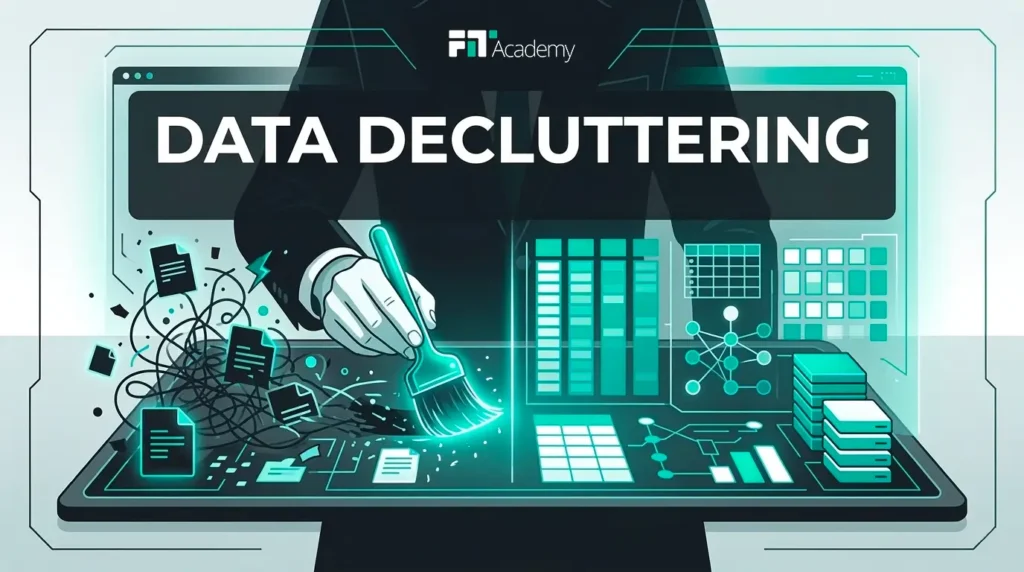
Enterprise Data Decluttering: the ability to intentionally reduce obsolete information assets is becoming one of the most underrated levers in corporate data strategy.
Yet almost no organization has this competency in-house yet.
The Corporate Data Paradox: accumulating is easy, deleting is strategic
For years, data management has looked in only one direction: growth. More data, more systems, more analytics. Very little attention has been paid to the other half of the data lifecycle: its conscious reduction.
Deleting obsolete data, decommissioning unused databases, and shutting down legacy systems are universally recognized as best practices, but they are rarely treated as a genuine strategic capability. The result is a corporate ecosystem weighed down by ROT data (Redundant, Obsolete, Trivial): data that takes up space, increases costs, and amplifies risk.
The phenomenon is even more evident in large enterprises: 71% have launched at least one AI project, and 84% have purchased generative AI tool licenses, an increase of 31 percentage points in a single year. In parallel, 47% of Italian workers already use AI tools in their daily work.
The critical point, however, is not how many are using it but how they are using it.
What is enterprise Data Decluttering and why it reduces Data Risk
In the Forbes article Data Erasers: The Strategic Team You Don’t Have (Yet), Nino Letteriello (FIT Academy) introduces a professional role that barely exists today but is destined to become crucial: Data Erasers. Not mere technicians, but professionals capable of deciding when and how a piece of data should reach the end of its lifecycle.
This approach, which we call Enterprise Data Decluttering in our whitepaper “Delete Your Data – Because It’s the Best Thing You Could Do Today” , is not an operational detail. It is a choice of strategy, efficiency, and digital sustainability.
Rethinking data deletion as a strategic lever produces at least eight measurable benefits:
-
Clearer, more readable information landscapes for the entire organization
-
Better operational performance of systems and applications
-
Direct reduction in storage and infrastructure costs
-
Stronger governance, greater accountability, and simplified compliance
-
Less complexity and technical debt in data ecosystems
-
Faster decisions with less informational “noise”
-
Lower exposure to regulatory, security, and privacy risks (including GDPR)
-
More resilient, scalable, and sustainable data environments over the long term
Data Erasers: The new custodians of digital sustainability
In a landscape where data grows at an exponential rate, data erasers become the custodians of corporate digital sustainability. They go beyond architecture or governance: they know how to assess the full lifecycle of an information asset — and have the courage to end it when it no longer generates value.
Whitepaper: Delete your Data, because it’s the best thing you could do today
Discover how the courage to delete can become a concrete lever for efficiency, governance, and data risk reduction.
FIT Academy translates this vision into concrete pathways for companies, supporting them across four key phases:
Identifying data and systems that are potentially obsolete or at ROT risk
Evaluating the costs, risks, and benefits of a possible decommissioning
Designing and executing safe, controlled data deletion plans
Measuring savings and impact over time through quantitative KPIs