
Data Decluttering: Why AI-Ready Data Starts With Less Data Chaos
Enterprise organizations are connecting more systems than ever. Data warehouses, data lakes, cloud platforms, SaaS applications, document repositories, operational databases and legacy archives are increasingly expected to feed analytics, RAG systems, copilots and AI agents.
But many organizations still struggle to answer a basic question: what data do we have, where is it, who owns it and do we still need it?
This is the real starting point for AI-ready data. Before making data available to AI systems, organizations need to make it manageable, relevant and trustworthy. Connecting everything is not the same as making everything useful.
Data Decluttering addresses this gap. It helps enterprises identify unnecessary complexity across their data environment, reduce redundant or obsolete information, clarify ownership and prepare a more reliable foundation for AI, analytics and governance.
What is Data Decluttering?
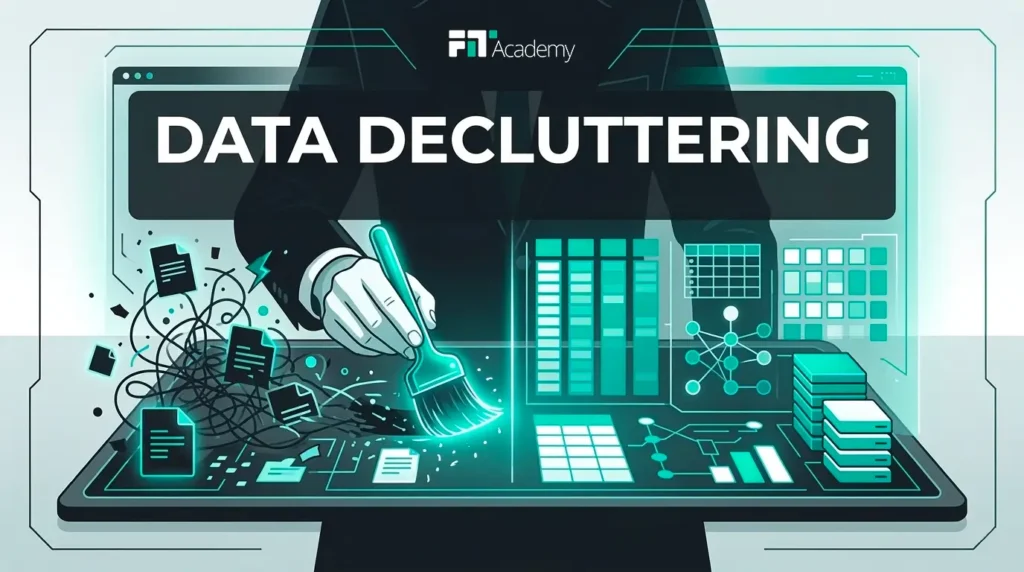
Data Decluttering is the process of identifying, assessing and reducing unnecessary complexity in an organization’s data environment, so that relevant information becomes easier to find, trust, govern and use.
It is not indiscriminate deletion. It is not only about saving storage space. It is not a technical cleanup performed once by IT. It is also not the same as backup or archiving.
Data Decluttering works on redundancy, duplication, obsolete information, unused data, unclear ownership, weak metadata, inconsistent taxonomies, unmanaged repositories, duplicated documents, retention rules and data quality. Its purpose is to make the enterprise data estate more understandable and more usable.
In practical terms, Data Decluttering asks: which information still creates value, which information creates risk or cost, and which information needs to be retained, archived, consolidated, improved or removed?
Why enterprise data environments become cluttered
Enterprise data clutter rarely appears overnight. It accumulates through years of projects, migrations, acquisitions, departmental initiatives, temporary exports, duplicated reporting processes and legacy platforms that remain active because nobody has formally decided what to do with them.
The result is a familiar pattern. Multiple teams maintain different versions of the same information. Nobody is fully sure which dataset is authoritative. Legacy repositories continue to grow. Business users save local copies because central systems are difficult to navigate. Metadata is missing or unreliable. Retention policies exist, but are difficult to apply in practice.
This creates a structural problem: the organization may have more data than ever, but less confidence in which data should be used.
When data complexity is left unmanaged, every new initiative inherits the same problem. A data governance program has to map unclear ownership. A modernization project has to migrate unnecessary history. An AI team has to spend months understanding sources before building anything valuable.
Why data clutter becomes a bigger problem with AI
AI increases the value of enterprise data, but it also makes information disorder more visible. RAG systems, copilots and AI agents can retrieve and process data quickly. That speed is useful only if the underlying information is relevant, reliable and governed.
If data is duplicated, contradictory, obsolete, unclassified or missing business context, AI can process the chaos faster. It does not automatically solve information disorder. It can expose it, repeat it or amplify it.
For example, a RAG system connected to duplicated policy documents may retrieve an outdated version. An internal copilot may answer using content from a repository no one owns. An AI agent may act on data that has not been classified for that use case. An analytics workflow may combine sources with conflicting definitions of the same customer, product or process.
This is why AI readiness cannot be reduced to access. Access matters, but access without relevance and governance can create unreliable outcomes. AI-ready data needs context, ownership, quality signals, lineage, retention logic and usage boundaries.
More data is not always better data
The assumption that more data automatically creates better AI is too simplistic for enterprise environments. More data can mean more signal, but it can also mean more noise, more duplication, more conflicts, more outdated content and more governance complexity.
The point is not to have less data at all costs. The point is to have the right data, for the right use case, with the right context and governance.
This distinction matters because enterprise AI projects often start by trying to connect as many sources as possible. That can be useful when the data estate is already understood. It becomes risky when the organization does not know which sources are authoritative, which datasets are duplicated, which documents are obsolete or which repositories contain sensitive information.
Data Decluttering gives AI teams a cleaner starting point. By reducing irrelevant and redundant information, it helps make the remaining data easier to evaluate, govern and activate.
Connected data is not automatically useful data
The market is moving toward platforms that connect, govern, contextualize and activate enterprise data for AI. IBM watsonx.data is one example of this direction: IBM describes it as an open, hybrid data foundation for connecting, understanding, governing and optimizing AI-ready data across hybrid environments. Its positioning reflects a broader enterprise need: fragmented data must become governed, context-rich and usable for AI.
That direction is relevant, but it does not remove the need for an earlier organizational step. Before organizations connect and activate more data, they need to discover, assess, declutter and govern what already exists.
This is the FIT Academy perspective: discover, assess, declutter, govern, connect, activate.
In other words, technology can help enterprises access and govern distributed data. But technology alone cannot decide which outdated documents should be removed, which redundant repositories should be consolidated, which legacy systems no longer justify their cost, or which business owners must take responsibility for specific information assets.
Connected data becomes useful only when it is relevant, trusted and governed.
The business cost of data clutter
Data clutter creates business cost even when it is not visible in a single budget line. Teams lose time searching for the right document. Analysts compare multiple versions of the same dataset. AI initiatives spend months in discovery. IT maintains legacy systems without a clear business reason. Storage and infrastructure costs grow without a proportional increase in value.
The costs are operational, financial and strategic.
Operationally, clutter slows people down. If information is scattered across multiple systems, every decision requires extra verification. Financially, redundant data increases storage, backup, migration and infrastructure complexity. Strategically, poor data trust limits the effectiveness of analytics and AI.
There is also a compliance dimension. If retention rules are unclear and data ownership is weak, organizations may keep information longer than necessary or fail to apply consistent policies. The European Commission’s guidance on GDPR data minimization reinforces the principle that personal data should be limited to what is necessary for the stated purpose.
Data clutter is therefore not just an inconvenience. It is a source of friction, cost and risk.
10 signs your organization needs Data Decluttering
An organization should consider Data Decluttering when the symptoms of data complexity begin to slow AI, governance or modernization work. Common signs include:
- You do not know exactly what data you have.
- Multiple teams use different versions of the same data.
- Legacy repositories continue to grow without clear purpose.
- AI projects are blocked by long data discovery phases.
- Search and RAG systems return duplicate or obsolete content.
- Data ownership is unclear or disputed.
- Retention policies are inconsistent or difficult to apply.
- Data Governance initiatives struggle to move from policy to execution.
- Storage keeps increasing without clear business value.
- Nobody feels confident deleting anything.
These signs matter because they indicate that the organization is not only dealing with data volume. It is dealing with data ambiguity.
How Data Decluttering prepares data for AI
Data Decluttering prepares enterprise data for AI by creating a more manageable foundation before advanced systems are connected to it.
1. Discover
The first step is to map existing sources, repositories, applications, datasets and document stores. This gives the organization visibility over what exists and where complexity is concentrated.
2. Assess
The second step is to evaluate relevance, quality, ownership, duplication, usage, cost and risk. This helps distinguish valuable information from redundant, obsolete or low-value assets.
3. Classify
The third step is to decide what should be retained, archived, consolidated, improved, anonymized or removed. Classification prevents decluttering from becoming arbitrary deletion.
4. Declutter
The fourth step is to reduce duplication and unnecessary complexity. This may include consolidating repositories, removing obsolete documents, rationalizing legacy databases or reducing redundant copies.
5. Govern
The fifth step is to define ownership, metadata, retention, quality rules and access principles. Governance ensures that the same clutter does not return immediately after the cleanup.
6. Prepare for activation
The final step is to make the remaining data easier to use for analytics, AI and operational processes. At this stage, data is not only connected. It is clearer, more relevant and better governed.
Data Decluttering and ROI
The ROI of Data Decluttering should not be measured only in storage reduction. Storage matters, but the broader value is created by reducing operational friction across the data lifecycle.
A structured initiative can support faster data discovery, lower duplication, better Data Quality, clearer ownership, reduced infrastructure complexity, more reliable analytics, faster AI project preparation, improved RAG retrieval quality, easier governance, reduced compliance exposure and clearer retention policies.
These benefits are especially relevant for organizations preparing for AI. When teams spend less time understanding which data is usable, they can spend more time validating use cases, improving model outcomes and building governance into production workflows.
The business case becomes stronger when Data Decluttering is measured with practical KPIs: repositories assessed, duplicate sources reduced, legacy systems rationalized, datasets classified, ownership assigned, obsolete documents removed, discovery time reduced and AI-ready sources prioritized.
From data accumulation to data intentionality
For years, the default enterprise behavior has been accumulation. Store more. Copy more. Connect more. Keep more, just in case.
AI makes this model harder to sustain. It increases demand for trusted data, but also raises the cost of disorder. When AI systems can access more information, the organization must become more intentional about which information should be available, under which policies and for which use cases.
Data intentionality means treating data as an asset with a lifecycle, not as something to keep indefinitely by default. Some data should be protected and activated. Some should be archived. Some should be improved. Some should be removed. Some legacy systems should be retired.
This is where Data Decluttering becomes a strategic business initiative, not simply an internal cleanup exercise.
Start with clarity before adding more technology
Before investing in another platform, migration or AI initiative, organizations should first understand how much unnecessary complexity already exists in their data estate.
FIT Academy’s Data Decluttering approach helps organizations identify redundant, obsolete and poorly governed information, clarify ownership and define a practical roadmap toward cleaner, more governable and AI-ready data.
How much data complexity is your organization carrying?
Talk to FIT Academy about a Data Decluttering assessment and identify where unnecessary complexity may be slowing your AI, governance and data transformation initiatives.
What is Data Decluttering?
Data Decluttering is the process of identifying, assessing and reducing unnecessary complexity in an organization’s data environment, so that relevant information becomes easier to find, trust, govern and use.
Why is Data Decluttering important before AI projects?
Because AI systems depend on the quality, relevance and governance of the data they access. If the data estate contains duplicates, obsolete documents and unclear ownership, AI can amplify those problems.
Is Data Decluttering the same as data cleanup?
Not exactly. Data cleanup is often technical and local. Data Decluttering is broader: it includes ownership, metadata, retention, duplication, governance, risk, business relevance and lifecycle decisions.
Does Data Decluttering mean deleting data?
Sometimes, but not always. It can also mean retaining, archiving, consolidating, anonymizing, improving or reallocating data. Deletion should be controlled, documented and aligned with legal and business requirements.
How does Data Decluttering improve RAG and enterprise search?
It reduces duplicate, obsolete and low-quality documents before retrieval systems use them. This can make search and RAG outputs more relevant, consistent and easier to govern.
An organization should start when teams cannot find authoritative data, AI projects are blocked by discovery, ownership is unclear, legacy repositories keep growing or nobody feels confident deleting anything.
It reduces duplicate, obsolete and low-quality documents before retrieval systems use them. This can make search and RAG outputs more relevant, consistent and easier to govern.