
Agentic AI Is Changing the Role of Data Governance
Agentic AI is moving artificial intelligence beyond the familiar role of generating text, summarising documents, or answering questions. An AI agent can interpret information, plan a sequence of steps, select tools, interact with applications, and execute actions toward a goal. That shift creates a practical question for every organisation experimenting with enterprise AI: what happens when autonomous systems act on unreliable data?
The answer is not that organisations should avoid autonomy. It is that autonomy changes the consequences of poor information. A wrong answer may mislead one user. A wrong action can update a system of record, trigger a workflow, affect a customer, or create new data that other processes will later treat as true.
The more autonomous AI becomes, the more important Data Governance becomes. Before AI agents can act reliably, the data they rely on must be governed, trustworthy, and fit for purpose.
From generating answers to taking action
Traditional generative AI is commonly experienced as a conversational system: a person provides a prompt and receives an output. The output may be useful, incomplete, or incorrect, but a human typically remains between the response and the next operational step.
Agentic AI changes that interaction model. As IBM’s technical overview of agentic systems explains, agents can plan tasks, invoke tools and resources, interact with external systems, and update systems of record. The degree of autonomy varies by design, permissions, and use case, but the important distinction is the connection between reasoning and execution.
This connection changes the risk profile of bad data. If an agent reads an outdated priority, a duplicate customer record, an incorrect product classification, or a missing contractual condition, the problem may not stop at interpretation. The agent may select the wrong next step and write the result back into the organisation’s information environment.
In simple terms, the failure chain can become:
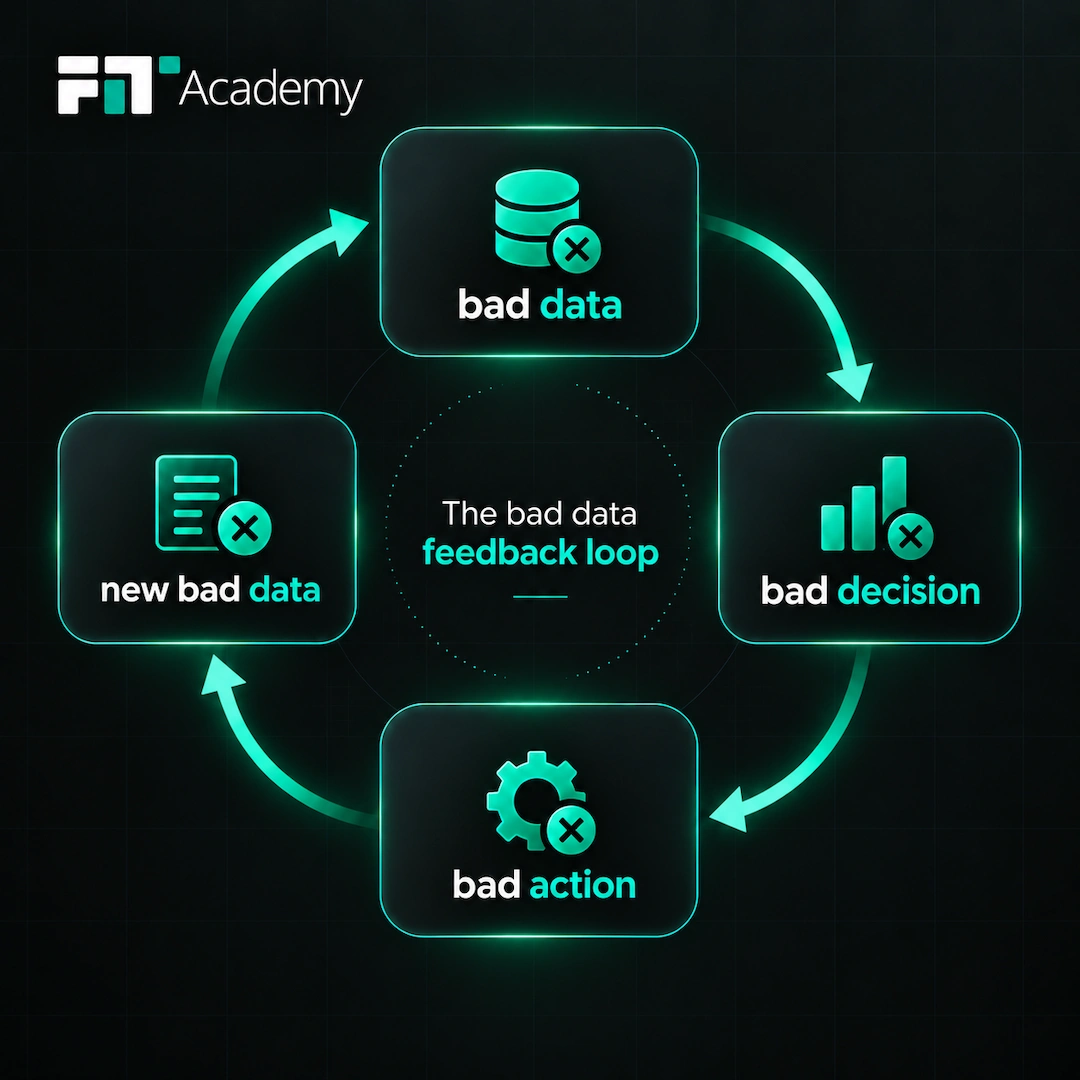
This is a useful way to describe the operational feedback loop created when AI can both consume and produce enterprise data. Once unreliable outputs re-enter shared systems, they may influence analytics, other agents, downstream automations, and future human decisions.
Automation can amplify poor data
Automation does not independently correct the process it accelerates. It can make a well-designed process faster and more consistent, but it can also reproduce weak classifications, ambiguous rules, and incomplete records at greater speed.
This is the central warning in Gartner’s public abstract for The ITSM Data Governance Playbook for Agentic AI Implementation, published on 13 Agosto 2026. In the context of IT Service Management, Gartner identifies data quality as a recurring implementation problem and points specifically to weak governance at intake. The abstract notes that inconsistent controls across intake channels can create unreliable records, distort metrics, and undermine automation and AI outcomes.
That observation matters because ITSM data is operational by nature. Incident categories, configuration records, priorities, service ownership, resolution codes, and knowledge articles do not merely describe the business. They influence what happens next. If those inputs are inconsistent, an AI agent may route a ticket to the wrong team, apply an unsuitable remediation, or infer patterns from categories that were never used consistently.
The lesson is not that AI is inherently dangerous. It is that AI effectiveness depends heavily on the quality and governance of the information it receives. Greater execution speed increases the value of good controls and reduces the time available to detect weak ones.
Governance must start where data enters the system
Many organisations treat Data Quality as a downstream activity. Teams reconcile records after ingestion, correct reports after discrepancies appear, and launch cleansing projects when operational pain becomes visible. Those activities remain necessary, but they are insufficient for agentic workflows.
When an agent may act within seconds, governance needs to move closer to data creation and acquisition. At the point of intake, organisations can establish mandatory fields, validation rules, consistent taxonomies, meaningful metadata, classification standards, and clear data definitions. They can also assign ownership and define quality controls for the data elements that influence important decisions.
This is more than form design. It is an operating model for information. A mandatory field adds little value if its definition is unclear. A taxonomy will not improve consistency if each function applies it differently. A validation rule can reject an invalid format, but it cannot decide whether the captured concept is the right one for the business purpose. Effective governance therefore connects technical controls with accountable owners, shared semantics, and feedback from the people who use the process.
For agentic AI, the point of creation becomes a control point. Preventing an ambiguous or incomplete record is usually safer and less expensive than detecting its consequences after an automated decision has already travelled across several systems.
Data Quality is becoming an AI reliability issue
Data Quality has traditionally been discussed in relation to reporting, regulatory compliance, analytics, and operational efficiency. Agentic AI adds another dimension: the reliability of automated behaviour.
Accuracy still matters, but fitness for purpose is broader than accuracy alone. An agent may need data that is complete enough to support a decision, current enough for the operating context, consistent across systems, uniquely identified, and accompanied by metadata that explains its meaning and provenance. A value can be technically valid yet still be unsuitable for the decision the agent is about to make.
The NIST AI Risk Management Framework treats trustworthiness as a lifecycle concern spanning the design, development, deployment, use, and evaluation of AI systems. In regulated contexts, the connection is even more explicit: For high-risk AI systems within its scope, Article 10 of the EU AI Act establishes specific requirements around data governance and the quality of training, validation and testing datasets.
Not every enterprise agent is a high-risk AI system under the Act, and regulatory obligations depend on the specific use case. The broader management principle is nevertheless useful: quality must be assessed against intended use. An agent that recommends a knowledge article has a different risk profile from one that changes payment terms, closes an incident, shortlists a candidate, or modifies a production schedule.
This means Data Quality thresholds should reflect the action, not only the dataset. The more consequential or difficult to reverse an action is, the stronger the requirements for validation, traceability, approval, monitoring, and human intervention should be.
You cannot govern AI without governing its data
AI Governance is often framed around models, prompts, guardrails, policies, access controls, and human oversight. All are important. But they cannot be separated from the information layer that shapes the system’s choices.
A complete AI Governance approach must ask where data came from, what it means, who owns it, how current it is, which transformations it has undergone, and whether it is appropriate for the intended decision. That brings Data Quality, metadata, lineage, ownership, architecture, and Data Governance directly into the AI control environment.
This integrated view reflects established Data Management practice. DAMA International describes Data Governance, Data Quality, Data Architecture, metadata, and integration as connected disciplines that help organisations control and enhance the value of data across its lifecycle. AI does not remove the need for these foundations. It gives them a new operational interface.
Organisations can make this connection concrete by governing the full agent lifecycle: the sources an agent may access, the meanings it is allowed to infer, the actions it may execute, the evidence it must record, and the conditions that require escalation. Model monitoring alone cannot reveal whether a business definition changed upstream or whether two systems assign different meanings to the same status. Those are Data Governance issues with direct AI consequences.
Beyond ITSM: the same challenge across the enterprise
Gartner’s research focuses on ITSM, where structured intake, routing, service records, and automation make the relationship particularly visible. The same logic can apply to many other settings in which agents work with enterprise data.
In CRM, duplicate accounts or inconsistent lifecycle stages can lead an agent to prioritise the wrong opportunity or contact a customer inappropriately. In customer service, weak entitlement data can produce an incorrect resolution path. In HR, unclear job or skills taxonomies can distort matching and workforce analysis. In finance and procurement, incomplete supplier, approval, or cost-centre data can send a transaction through the wrong control path.
Marketing agents may act on stale consent, fragmented audience definitions, or inconsistent campaign metadata. Operations agents may rely on asset, inventory, demand, or maintenance data whose quality varies by location. Enterprise data platforms may expose all of these sources to multiple agents, allowing one weak definition to propagate across use cases.
These examples do not imply that every data defect will cause a harmful action. They show why organisations need use-case-specific analysis. For each agent, leaders should identify critical data elements, decision points, permitted actions, downstream systems, reversibility, and accountable owners. The purpose is to understand where poor information could become operational behaviour.
The foundations of AI are still data foundations
Agentic AI may feel like a new layer of intelligence, but it operates inside an existing organisational reality: systems built over time, definitions negotiated across functions, records created through imperfect processes, and ownership distributed among people.
Reliable autonomy therefore depends on more than a capable model. It depends on whether the organisation can provide trusted context, clear semantics, controlled access, traceable lineage, fit-for-purpose quality, and accountable decisions. These capabilities are not supporting details. They are part of the operating foundation of enterprise AI.
This is also consistent with the integrated perspective represented by FIT Academy’s Data Management Lab Mandala: Data Quality, Data Governance, metadata, architecture, and AI-related capabilities are not isolated disciplines. They form an ecosystem in which foundations, organisational enablers, and transformative applications depend on one another.
The rise of AI does not make traditional Data Management less relevant. It makes the quality of its execution visible in every decision an autonomous system is allowed to take.
Why is Data Governance more important for Agentic AI than for a chatbot?
An AI chatbot mainly returns information to a user, while an AI agent may plan steps, call tools, update systems, or trigger workflows. Because the agent can act, weak data can affect an operational process rather than remaining only in a response.
What data quality dimensions matter most for AI agents?
The priorities depend on the use case, but accuracy, completeness, consistency, timeliness, uniqueness, validity, and fitness for purpose are common dimensions. Metadata and lineage are also important because they help explain meaning, origin, and transformation history.
Can AI agents improve poor-quality data automatically?
They can support detection, matching, enrichment, and remediation, but automation does not remove the need for definitions, ownership, controls, and validation. An agent operating on ambiguous rules may reproduce or amplify the same quality problems it is expected to solve.
Where should organisations start when governing data for Agentic AI?
Start with a bounded use case. Map the agent’s data sources, critical data elements, decisions, actions, downstream systems, and owners. Then define intake controls, quality thresholds, permissions, monitoring, escalation, and human-review points according to the consequences of the action.
Are AI Governance and Data Governance the same thing?
No. AI Governance covers the wider lifecycle, risk, accountability, oversight, and use of AI systems. Data Governance focuses on decision rights, policies, responsibilities, standards, and controls for data. They are distinct but interdependent because governed data is essential to reliable AI behaviour.

Before expanding an agentic AI initiative, examine the information pathway behind it: where critical data is created, how its meaning is controlled, who owns its quality, and what happens when an agent acts on it. Explore FIT Academy’s resources on AI Governance and the Data Management Lab Framework to continue the discussion across the connected disciplines of modern Data Management.